
How can 5 axis CNC reduce the production cycle of custom parts by 60% and lower costs by 40%
Introduction
The manufacturing of complex, multi-surface parts with traditional 3-axis CNC machining often necessitates multiple setups. This process introduces cumulative errors exceeding 0.1mm and extends production cycles by over 30%. The core issue is that 3+2 axis positional machining cannot optimize continuous toolpath, forcing manual finishing on complex surfaces and resulting in yield rates below 85%.
The solution lies in true 5-axis linkage technology, which integrates design and manufacturing, enabling ±0.005mm tolerances and complete part finishing in a single setup. The following analysis will delve into technical comparisons, case studies, and supplier evaluation criteria.
5-axis CNC Technology How to Reconstruct the Manufacturing Standards of Precision Engineering Parts?
The demand for higher standards in producing precision engineering parts is being met by advanced CNC Machining Services. True 5-axis technology fundamentally enhances dynamic accuracy and surface integrity.
Dynamic Precision and Thermal Error Compensation
A report by theNational Institute of Standards and Technology (NIST) on standards for digital manufacturing highlights that multi-axis systems can integrate real-time sensor data to actively compensate for thermal deformation of the machine tool. This is critical for maintaining the stability of a five axis CNC machine during prolonged operations, forming the foundation for achieving micron-level tolerances.
Geometric Improvement in Machining Efficiency
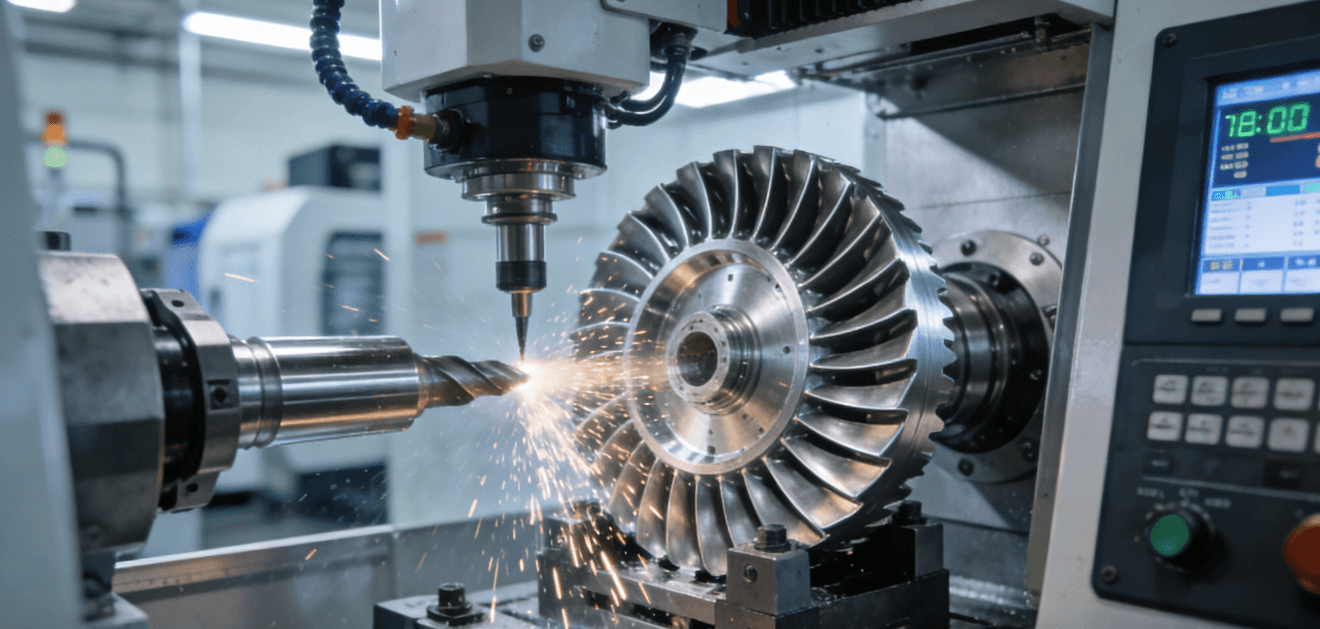
The difference in toolpath efficiency between 3-axis and 5-axis machining is clearly illustrated by analyzing a complex part like an aluminum alloy impeller.
- Limitations of 3-Axis Machining:
In the case of deep cavities, for 3-axis machining, longer tools are needed, resulting in reduced rigidity and increased vibration, resulting in a machining time of 8 hours per part.
- Advantages of 5-Axis Continuous Machining:
The angle of the workpiece is adjusted by the 5-axis technology, thus providing the best angle for the tool to reach the cutting zone. This results in the use of shorter and stiffer tools with increased feed rate, thus compressing the machining time to just 3 hours.
Exceptional Achievement of Surface Quality
A case stud involving an aerospace bracket demonstrates this capability. By utilizing a high-end DMG MORI machine. They completed all complex features in a single setup, achieving an exceptional surface finish of Ra 0.4m. Take for instance the case of an aerospace bracket. With the help of a top-notch DMG MORI machine, single setup was enough to manufacture all the complicated features, resulting in a surface finish of Ra 0.4m. This success showcases the value of professional 5 Axis CNC Machining Services in enhancing part performance.
Custom Parts Production How to Achieve On-Demand Delivery Through 5-Axis Technology?
In personalized medical and high-end equipment sectors, Custom Part Manufacturing is evolving towards low-volume, high-mix on-demand production. EU Medical Device Regulations (MDR) mandate strict traceability for each unit, a requirement that aligns perfectly with the flexibility of 5-axis technology.
The high flexibility of custom 5 axis CNC machining centers offers significant advantages in producing patient-specific implants like titanium cranial plates. Through simple program changes and quick tool swaps, these centers can directly machine custom data, drastically reducing the minimum order quantity from 50 pieces to 10, or even enabling single-part production. Integrated vacuum fixture systems can accommodate various blank shapes. Cutting fixture preparation time by up to 70%, truly enabling responsive, on-demand delivery.
Online Quotation System How to Accurately Evaluate the Cost of 5-Axis Machining?
For clients seeking Rapid Prototyping Solutions, a fast and transparent cost assessment is crucial. Modern online quotation systems integrate AI algorithms to automatically analyze a part’s geometric complexity.
The AI engine accurately identifies features like turbine blade warpage and deep narrow slots, predicting machining time and tool wear based on material and process databases. A comparative study from MIT on precision verification in smart manufacturing systems found that traditional manual quoting has an average error rate of 12% due to experiential variance, while advanced online AI quoting can reduce this error to within 3%. Furthermore, integrated material certifications ensure full cost transparency.
How to Choose a Rapid Prototyping Solution that Balances Accuracy and Traceability?
Selecting a reliable provider for Precision 5 Axis Machining Services requires a detailed assessment that is more than skin deep. The importance of accuracy and traceability is a major consideration, particularly within high-risk industries such as aerospace and medical.
Hard Certifications and Process Control
Evaluating a supplier requires scrutiny of their foundational certifications and operational controls.
- Objective Proof of Capability:
Suppliers must provide verifiable machine tool accuracy certifications (e.g., ISO 10791-2) and demonstrate complete material traceability to ensure source integrity.
- Control Over the Process:
Attention must also extend to their in-process inspection protocols and the efficiency of their emergency order response mechanisms, which reflect real-world operational discipline.
Certification Systems and Data Recording
Abiding by recognized quality management systems is imperative. Apart from the general ISO 9001 certification, different industries have taken the quality standards to a higher level with standards such as AS9100 (aerospace) etc. A procedural rigor of the highest level can be demonstrated by certifying compliance with these standards. These quality assurance systems require detailed data recording at every stage, so that any part can be located back to the specific lot of raw material, the exact machining parameters, and other manufacturing details, right through the final inspection and delivery stage.
Multi-Industry Application Validation
Practical, proven experience across sectors is the ultimate test of a supplier’s capability and adaptability. A qualified partner should demonstrate a portfolio of cross-industry applications. This versatility, as seen with proficient providers of 5 axis CNC machining service, validates not only technical expertise but also mature project and supply chain management essential for complex projects.
5-Axis Machining Centers How to Break Through the Process Bottlenecks of Difficult-to-Machine Materials?
Using traditional methods when machining Inconel 718 and titanium alloys results in low efficiency and high tooling costs. Advanced 5 axis CNC technology is a great help in opening new strategic ways to get rid of these limitations.
5-axis synchronized trochoidal milling of Inconel 718 results in constant tool engagement and load which is considered to be the main factor behind 300% improvement in tool life over conventional methods. To add that, environmental management systems such as ISO 14001 focus on cutting fluid recycling which not only helps in enhancing sustainability but also leads to a significant reduction in per-part cost. Thin-walled parts which are extensible to distortion can be effectively handled and their dimensional stability can be secured by the use of high-pressure internal cooling systems which target the thermal growth through the prevention of heat generation.
Conclusion
In conclusion, 5-axis CNC technology essentially changes whole way manufacturing complex parts from integrated production, real-time monitoring, and flexible systems, radically improving efficiency and precision control. It is a powerful tool that not only drives machining but also design, innovation and supply chain optimization.
Send your 3D model to our technical team to get a made-to-measure parts processing solution verification report and our experts will carry out a comprehensive manufacturability analysis including tolerance assessment.
Author Biography
The author is an expert in the field of precision manufacturing, with over fifteen years of experience in applied research of multi-axis CNC technology, deeply involved in the formulation and optimization of process standards for high-precision parts in the aerospace sector.
FAQ
Is 5-axis CNC suitable for small-batch medical device prototyping?
Highly suitable. 5-axis technology completes multi-angle features in a single setup, eliminating positioning errors from re-fixturing. It is ideal for prototypes like bone screws requiring ±0.01mm tolerances, offering significant cost-effectiveness for batches of 5-50 pieces.
Does the online quote include post-processing fees?
The initial quote covers standard CNC machining and basic deburring. Special requirements like mirror polishing or penetrant testing require manual review. The final quote will provide a detailed breakdown with a clear price range.
How to verify the accuracy of a supplier’s 5-axis equipment?
Request recent machine calibration certificates per standards like VDI/DGQ 3441. Also, review recent third-party CMM reports for similar parts, focusing on dynamic accuracy compensation data and repeatability positioning error values.
What is the maximum length-to-diameter ratio for machining titanium alloy parts?
Standard 5-axis setups handle a tool length-to-diameter ratio of 1:10. Using dampening tool holders can increase this to 1:15. Deeper structures require segmented machining with process simulation to avoid chatter.
What is the difference in surface roughness between 5-axis and 3+2 axis machining?
5-axis continuous cutting produces a uniform texture with Ra values stably between 0.4-0.8μm. 3+2 axis discrete machining creates peak-to-valley variations of 0.2-0.5μm at toolpath junctions, adversely affecting the fatigue life of critical components.