
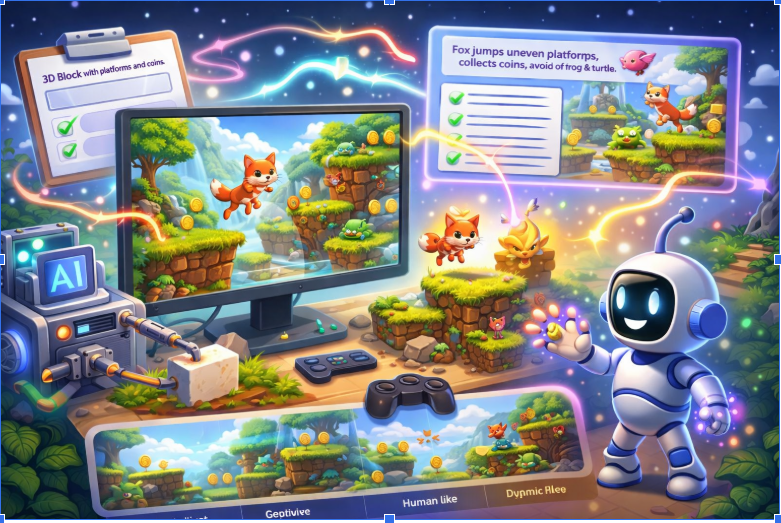
Make AI Games using AI Game Maker Platform
Many people create their first game by describing the idea in a few sentences and generating it quickly. The result usually works the character moves, things appear on screen, and there is a basic goal, but it often feels mechanical or lifeless. Players try it for 20–30 seconds, notice the repetition, the perfect symmetry, or the lack of personality, and close the tab. This happens because the initial description is usually too general or safe, so the game follows predictable patterns without the small imperfections, surprises, or warmth that make human-made games feel alive.
The good news is you can add that human touch by refining your description with specific details about uneven placement, subtle imperfections, personality in characters, emotional feedback, and natural flow. You make one change at a time, generate a new version, play it yourself, and adjust until the game stops feeling robotic and starts feeling like something a person poured care into. This guide explains why generated games often feel cold and gives clear, practical steps to make them feel warm, organic, and human. After a few focused updates, your game will draw players in and keep them playing longer because it feels made by someone who cares.
Why Generated Games Often Feel Mechanical and Lifeless
When you write a short description like a Parkur 3D Block with platforms and coins, the no code game tool creates clean, balanced layouts to avoid obvious errors. Astrocade appear at regular intervals, enemies patrol in perfect lines, backgrounds repeat the same pattern, and collectibles sit in neat rows. Everything functions correctly, but nothing surprises or delights.
There is no sense of hand-crafted care, no slightly crooked path, no hidden corner, no quirky detail that makes you smile. Players sense the absence of human decision-making, so the game feels like a template rather than a creation. Human designers add intentional imperfections on purpose: a slightly wider gap to create tension, a cluster of coins that tempt a risky jump, a background object that hints at a story. These choices make levels feel alive and thoughtful. Generated games skip them unless you ask explicitly. The fix is describing variation, personality, and emotion instead of just mechanics.
Add Natural Imperfections and Uneven Placement
Perfect symmetry feels artificial. Real worlds are uneven, the ground is bumpy, trees lean, and paths curve. Add these imperfections to make levels feel hand-placed.
Here are practical ways to introduce natural unevenness:
- Platforms at slightly different heights and angles instead of flat rows.
- Gaps that vary from narrow to wide rather than all the same distance.
- Collectibles are grouped in small clusters instead of one every few steps.
- Small empty pockets or quiet corners after busy sections for breathing room.
Describe: platforms placed unevenly with natural variation in height and spacing, some tilted 10–20 degrees, collectibles clustered near risky jumps, occasional open areas for rest. Play the level. Does it feel like a real place instead of a grid? Uneven details create organic flow and make exploration more interesting.
Give Characters and Enemies Personality and Quirks
Generic characters and enemies feel like placeholders. Human designers give them small traits that make them memorable.
Here are ways to add personality:
- The main character has a little bounce when idle, wobbles when hurt, and smiles on collect.
- Enemies have unique walks: some hop, some slither, some flap wings unevenly.
- Reactions vary: defeated enemies fall in funny poses or leave behind a tiny item.
- Background creatures move independently: birds fly past, leaves drift.
Describe: fox character bounces gently when waiting, tail sways, ears twitch on jump; birds flap unevenly and chirp randomly; defeated enemies tumble comically with small puff of smoke. These quirks make the world feel lived-in and give players a smile.
Layer Emotional Feedback and Satisfying Moments
Flat actions make games feel cold. Every success or failure needs a small emotional payoff to feel human.
Here are refinements for emotional connection:
- Collect item: bright burst of particles, cheerful sound that rises in pitch, brief screen flash.
- Jump land: small squash-stretch animation, soft thud, dust kick-up.
- Near miss: slow-motion for half a second with heartbeat sound.
- Win: confetti rain, victory tune swells, character does a happy spin.
Describe: every collect gives sparkling explosion, rising chime, and quick joy pop-up; near falls show slow-motion replay with tense music sting. Test 10 actions, do they make you feel good? Emotional feedback creates attachment.
Vary Rhythm and Pacing for Organic Progression
Constant pace feels robotic. Human levels have a changing rhythm: quiet moments, tense builds, rewarding peaks.
Vary pacing across the level:
- Early gentle sections with wide spaces and slow threats.
- Middle faster bursts with shorter gaps and quicker enemies.
- Late explosive mix of everything with big payoffs.
- Include recovery areas after hard parts for calm breathing.
Describe: pacing starts relaxed with open areas, speeds up gradually with tighter rhythm, peaks in the final third with combined challenges, ends calm path to the goal. Play full level, does energy rise and fall naturally? Organic pacing prevents fatigue and builds satisfaction.
Test for Human Feel Through Full Playthroughs
Humans feel it in the whole experience. Isolated sections hide repetition.
Testing approach:
- Play the entire level set back-to-back 3 times, note where sections feel too similar or mechanical.
- Time each level and mark where energy drops or spikes unnaturally.
- Ask 2–3 friends to play through: which parts felt most natural, which robotic?
- Regenerate after one change (imperfections, personality, pacing), compare side by side.
On Astrocade, a quick no code game maker lets you iterate level sets fast. Aim for every level to feel distinct yet part of the same world.
Example of a Game with Human-Like Natural Feel
A strong example is a parkour 3d block where levels feel like exploring real places. Early stages open fields with gentle hills and scattered coins. Middle levels shift to dense forests with vines, narrow logs, and hidden paths. Late stages become mountain cliffs with wind gusts, crumbling ledges, and distant peaks guiding forward. Obstacles cluster naturally, rocks near waterfalls, spikes in caves, creating organic flow.
Final Steps to Make Your Game Feel Human
Human feeling comes from imperfections, personality, emotional feedback, and natural pacing. Start by describing uneven placement and purpose for each level group, then add character quirks, satisfying reactions, and changing rhythm. Generate the full set, play through in order, and adjust the weakest spots. Your levels now? Pick one mechanical section, add natural clusters, a quirky enemy, and emotional pop. Regenerate, play the sequence. Feel the difference. Repeat across the game. Soon, every level will feel like a small adventure made with care, not a copy-paste. Players finish saying that felt real and fun. Keep refining, human-feel games become the ones people remember and share.
Disclaimer
This article is intended for informational and educational purposes only. While it provides guidance on using AI Game Maker platforms and improving game design quality, results may vary depending on the tools, platforms, and individual implementation. Any references to specific platforms, tools, or examples (such as Astrocade or no-code game makers) are for illustrative purposes only and do not constitute endorsement or guarantee of performance. Readers are encouraged to explore different tools and apply their own judgment when creating games. The author and publisher are not responsible for any outcomes, technical issues, or results arising from the use of the information provided in this content.