
Avoid These 5 CNC Milling Design Mistakes: A Guide to Save 25% Costs for Aerospace and Automotive Projects
Introduction
Many projects in highly regulated industries, such as aerospace and automotive manufacturing, via CNC milling machines, have a tendency to go over budgets and deadlines. This is because the issues that cause the overruns were found not to be cause by the machining process alone, but more by the design process where by the fundamental principles of geometric dimensioning and tolerancing are not fully understood and apply.
The paper recommends a data-driven strategy that refers to international standards like ASME Y14.5 and ISO 9001. This serves as a means to avert potential unseen problems, at the same time achieving cost savings without quality and reliability being compromise.
What Is CNC Milling and How Does It Work?
CNC Milling is an abbreviation that stands for Computer Numerical Control Milling. It is a subtractive manufacturing process that involves running different tools and machines within a manufacturing plant using a software program. CNC Milling is a manufacturing process that changes a raw material from any original form to a desired form by a series of cutting actions using rotating cutting tools at a high rate of speed. It is a 3D CAD design concept. The CAD design is then translate into a programming language that is refer to as G-Code that is use to program the CNC Milling machine.
1. The Digital Workflow: From CAD to Finished Part
The method starts with (CAD) in which the shape of the part is figured out. This data is then load into CAM) where the actual tool paths are generate. Still, one major thing should be look at during this phase is the correct application of GD&T principles, per the description in standards likeASME Y14. 5.
2. The Role of Multi-Axis Machining Kinematics
While a standard 3-axis machine operates by moving along linear paths along X, Y, and Z axes, a more advanced machine may have additional axes of rotation such as A, B, or C axes. This enables the tool to approach the workpiece from a wide range of angles within a single setup. The dynamic tool orientation is a fundamental capability that is necessary for creating intricate shapes without introducing errors that come from moving the workpiece several times.
Achieving Precision Through Controlled Material Removal
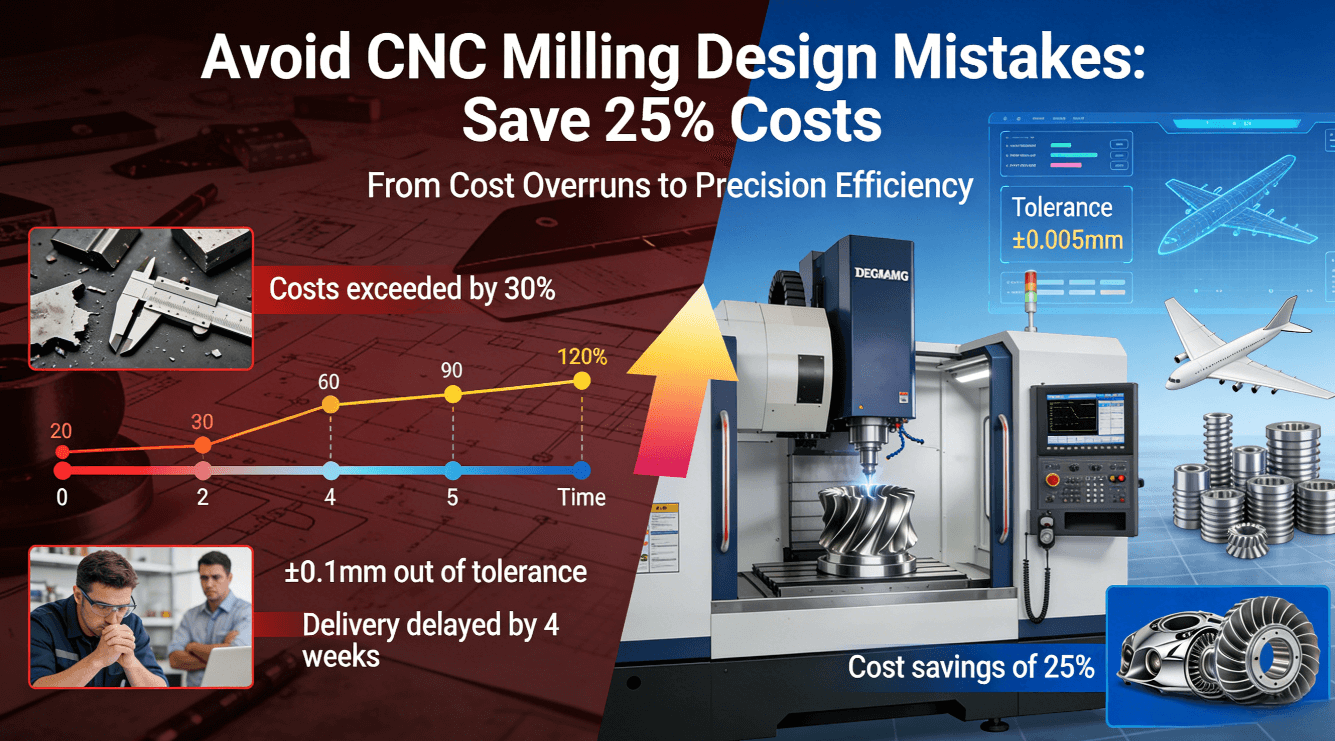
The fundamental idea behind the milling process is the removal of materials. Parameters like cutter, step over, and chip load are carefully calculate. The idea is to get the job done with the require finish and tolerances in the least possible steps. CNC milling machines, if properly programmed, have tolerances as small as ±0.005 mm, thus becoming indispensable for the industry.
How Does 5-Axis Milling Enhance Precision for Complex Parts?
The limitation of the traditional 3-axis machining method is that it “hits a wall” on parts that have deep cavities, undercuts, and contoured surfaces. The limitation of the traditional method is addressed by the 5-axis CNC machining method because it allows the cutter to move simultaneously in five axes and maintain the “optimal position relative to the workpiece surface”.
- Eliminating Cumulative Error with Single-Setup Machining: Perhaps the greatest benefit of using a 5-axis machine is the reduction of errors that result from multiple set-ups. In a 3-axis machine, each time a part is reposition. A new reference point is establish, and errors may result from misalignment. A 5-axis machine, however, finishes a part in a single set-up, where all parts are made with reference to a single reference point. This, by itself, is a huge benefit for geometric accuracy and is a requirement for meeting the stringent tolerances set by ASME Y14.5.
- Overcoming Geometric and Tool Accessibility Challenges: A 5-axis machine has two axes of rotation and thus the ability to tilt the tool or the part being cut so that areas that would be inaccessible by a straight vertical cut become accessible. This eliminates the need for an expensive and complex set-up and allows the creation of a monolithic part, whereas the 3-axis machine would have to assemble several parts that would be assemble at a later time. The part is not only stronger, it is also cheaper and quicker to assemble.
- Improving Surface Finish and Tool Life: The fact that there is an option of using short and stiff cutters, as well as the option of using flank instead of point cutting, all contribute to an improved finish on the machined surface of the contour. Moreover, there is an extension in tooling time and an increase in cutting speed due to the fact that chip load and cutting angle are kept constant, thus improving efficiency.
What Are the Key Materials for CNC Milling and How to Choose Them?
The selection of the materials is a critical cost-performance trade-off. If the materials are not select properly, it may result in premature failure of the component, higher machining costs, and unnecessary costs. The materials are require to be select on the basis of their machinability and budget.
Aluminum Alloys: The Standard for Prototyping and Lightweight Parts
The Standard for Prototyping and Lightweight Parts Aluminum alloys such as 6061 and 7075 are some of the most widely use materials that provide excellent strength-to-weight performance, good resistance to corrosion, and they are very easily machinable. These are the ones that are most commonly chosen for airframe structures, automotive parts, rapid prototyping mainly because of their high machinability rate allowing for shortening of machining operations time.
Stainless Steels and Titanium: For High-Strength, Corrosion-Resistant Applications
On the other hand, extremely strong, ductile, and tough materials resistant to both highest and lowest temperature extremes and corrosive environments are among the primary mechanical properties of heavy-duty operations. Stainless steel grades 304 and 316 as well as titanium alloys grade 5 and Ti-6Al-4V will be the first choice in such cases however these materials are hard and expensive to machine. For more information on how to choose the material, visit the blog of a professional precision CNC milling service.
Engineering Plastics and Composites for Specialized Needs
Take, for instance PEEK Ultem as well as carbon fiber composite materials having some exclusive features such as chemical resistance, electrical insulation, and low densities. They look for special tools and parameters to be machine so that delamination and heat deformation are prevent. However, they represent the greatest choice forcertain aerospace, automotive, and medical industry applications.
How Can CNC Milling Solve Challenges in Aerospace Manufacturing?
The industry that I believe is one where you must ensure that your product is reliable and performs well is the aerospace industry. At the same time, this industry is always trying to ensure that it reduces the weight of its products without compromising on quality and safety. However, underlying all these complex problems is CNC Milling, particularly 5-axis CNC Milling.
1. Mastering Complex Aerodynamic Geometries
Elements like blades, ribs, and ducts of an airplane have to be extremely intricate and natural looking. And these kinds of shapes are not producible by the traditional manufacturing processes. But by using a 5-axis CNC Milling machine now it is feasible to make these kinds of shapes out of a single piece of metal.
2. Implementing Rigorous Quality Control and Traceability
Manufacturing processes in the aerospace industry are required to follow specific standards such as AS9100D, which is primarily base on the quality management principles of ISO 9001. This entails that each milled part should undergo very thorough in-process and final inspections with the aid of CMMs (Coordinate Measuring Machines) and other precision measurement instruments. All the measurement results need to be well documented with complete traceability, an absolute requirement in safety-critical operations.
3. Achieving Lightweighting Through Design for Manufacturability (DFM)
A key factor in the aerospace industry is the ability to weight reduction without sacrificing strength. Using DFM analysis methods, engineers are now able to create parts with very thin walls and complex internal features that 5-axis milling machine would be the only way to manufacture them. Such process is call lightweighting, and it is one of the main contributors to fuel economy and payload.
What Quality Control Measures Ensure High-Performance CNC Milled Parts?
Investing in high-tech equipment is a waste without a strong Quality Management System (QMS) in place. The key to being a reliable supplier is having a systematic approach to quality control.
- In-Process Monitoring and Closed-Loop Systems: High-end CNC milling equipment has been available with on-machine probing systems that allow critical dimensioning to take place during or after processing. This information is then used to automatically compensate for tool wear or thermal expansion in a closed-loop manufacturing environment.
- Final Inspection Against Digital Twins: The final phase is a thorough check of the parts post machining. Generally, a CMM is the tool of choice for such operation. The parts are match against their initial CAD models (digital twin), and a detail report is create. This critical step helps make sure that the parts meet the stipulated GD&T specifications.
- The Role of Certifications like ISO 9001:2015: Adherence to international standards like ISO 9001:2015 on the part of the manufacturer is an excellent pointer towards an advanced QMS. ISO 9001:2015 is an international quality management standard that focuses on continuous improvement, management via process approach, and procedural documentation in order to ensure that quality is infuse into every aspect of the workflow.
How to Select a CNC Milling Service Provider for Cost-Effective Projects?
The selection of the appropriate CNC milling service is just as important as the design itself. A competent supplier could be an extension of your design team, offering not just the service itself but also expertise
1. Evaluate Technical Capabilities and Technology Stack
You should choose a company that offers not only the latest CAM software for your production. But also a broad range of machines such as multi-axis CNC milling machines. The ability of the supplier to fulfill your exact material demands constitutes an extremely important factor in choosing a supplier. That said, you should also inquire about their expertise in dealing with projects similar to yours in your sector.
2. Scrutinize Their Quality Management and Certifications
Today, literally anyone with a computer can claim that their one-man operation is a service provider and can get your business. So it is getting more and more necessary to prove yourself, also in the industrial part of the supply chain. Understanding a supplier’s capabilities through their certifications and insight into their quality management system is an excellent starting point. Although ISO 9001 is a fundamental standard, aerospace suppliers will typically have the AS9100D certification while medical device manufacturers will have ISO 13485, showing that these suppliers have a thorough understanding of their customers’ needs in these particular areas.
3. Assess Their DFM Feedback and Communication
One of the earliest considerations when selecting a supplier would be to check if the supplier can generate a Design for Manufacturability (DFM) report for you alongside your price quotation. Such a document, pointing out areas which might be change from a cost, reliability, and manufacturability perspective, is very helpful. It would be essential to ensure that the suppliers can communicate openly throughout theproduction process.
Conclusion
The prevention of costly CNC milling design errors requires a proactive approach, incorporating new technologies with rigorous design criteria. As a result, with the benefits of 5-axis machining technology and materials, combine with a supplier who is dedicate to quality, engineers in the aerospace and automotive industry are able to reduce costs, speed up the design and manufacture process, and produce products to the highest standard of accuracy and quality.
FAQs
What is the typical tolerance achievable with CNC milling?
CNC machines enable the milling to be precise in extremely small scales, reaching up to 0.005 mm. This degree of accuracy is almost the yardstick at the microscopic range. With such ultra-precision, it becomes realistic to meet the most demanding specifications of highly critical parts, foremost in the aerospace.
What materials are best for high-strength CNC milling applications?
Titanium and stainless steel can be mention as the materials that are carefully most frequently select for very strong milling operations at CNC. These metals have the right features to serve well in certain situations like the automotive industry.
What is the duration of time between CNC milled parts from a prototype phase and production phase?
It depends on the time frame and rapid prototyping services may be done within one or two days while production parts may take a week or two at most, depending on how the CNC milling service provider schedules production.
What are the specific types of certifications that I should look for with a CNC milling service provider?
My suggestions for types of certifications you would want to see at a CNC milling supplier will be ISO 9001 for standard of quality management systems and AS9100D for the Aerospace industry quality management system.
Author Bio
The author is a precision manufacturing expert at LS Manufacturing, Co. The company is focus on helping engineers and researchers solve different challenging problems of parts for the aerospace, medical, and automotive industries. Each member of their team has very specialized certifications such asIATF 16949 and AS9100D making them capable of delivering the highest quality solutions to clients by using the latest technologies. If you want to learn more, please contact them today to get a free consultation and DFM evaluation with no obligation. Make your idea a cost-effective reality.